More Than a Machine Operator
Cancer remains one of the defining healthcare challenges of our time. As incidence rates climb globally, the pressure on oncology teams intensifies - and Radiation Therapists sit at the very centre of that challenge. We are not peripheral; we are pivotal.
Whether you are a newly qualified RTT stepping into the treatment room for the first time or a senior clinician years into practice, the role demands the same core qualities: technical precision, clinical judgment, compassionate communication, and the psychological resilience to walk alongside patients through one of the most difficult experiences of their lives. What changes with experience is scope - the amount of independent judgment, mentorship, and service-level responsibility you carry - not the underlying standard of care.
Clinical Practice & Patient Care
At its core, our role is about delivering safe, evidence-based radiotherapy across a range of tumour sites. This means working within regulatory frameworks - the UK's IR(ME)R and IRR, India's AERB (Atomic Energy Regulatory Board), and international ICRP guidelines - not as bureaucratic formality, but as a genuine commitment to patient and staff safety.
Every treatment day begins with a patient assessment. Are they tolerating treatment? Have new side effects emerged? Is there pain, anxiety, fatigue, or financial stress affecting compliance? Identifying these concerns early and escalating when needed is a core clinical responsibility.
- Deliver radiotherapy safely across diverse tumour sites using advanced techniques
- Perform daily assessments monitoring treatment tolerance and side effects
- Provide clear, compassionate communication and emotional support throughout the journey
- Manage holistic care including positioning, mobility assistance, and emergency workflows
- Uphold empathy in managing psychosocial concerns, anxiety, financial stress, fear of treatment
- Conduct treatment chart, plan, and dose audits to catch discrepancies before they compound over a fractionated course
- Manage patient scheduling and re-slotting during machine downtime, balancing clinical priority against delay
The emotional dimension of this work is often underappreciated. Patients arrive frightened. They leave - session after session - having placed enormous trust in us. That trust must be earned and maintained consistently.
Pre-Treatment & Treatment Delivery
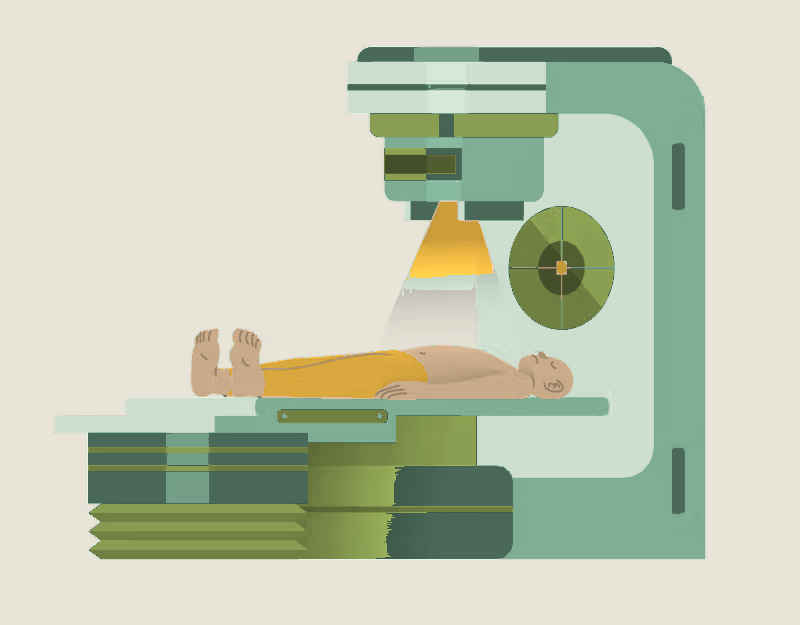
The technical scope of a Radiation Therapist is substantial. Operating a Linear Accelerator, Tomotherapy platform, or CyberKnife system requires both knowledge and instinct - understanding not just how the machine behaves, but how the patient is responding in real time.
Radiotherapy techniques have evolved dramatically. Today's RTTs must be confident across modalities including:
- 3DCRT, IMRT, and VMAT (three-dimensional conformal, intensity-modulated, and volumetric arc therapy) for conformal and volumetric dose shaping
- IGRT and CBCT-guided workflows for daily positional accuracy
- SBRT and SRS (stereotactic body and stereotactic radiosurgery) for high-dose, hypofractionated treatments
- Specialist procedures such as TBI (Total Body Irradiation), TMLI (Total Marrow and Lymphoid Irradiation), and Cranio-Spinal Irradiation - complex treatments that call for an experienced RTT leading delivery with an independent peer check, as with any high-risk procedure
Accurate patient set-up and immobilisation is non-negotiable. Every millimetre matters in modern radiotherapy. CT simulation, image fusion, and verification imaging form the backbone of reproducible treatment delivery.
Before a single patient is treated each day, the machine itself has to earn that trust. Morning QA - output checks, interlock tests, laser and imaging alignment - is run and signed off before the first fraction, and every field delivered is logged and cross-checked against the prescription in a verify-and-record system such as Mosaiq or ARIA. It is unglamorous work, but it is the safety net the rest of the day depends on.
Imaging & Verification
Modern radiotherapy is an imaging-intensive discipline. From simulation to daily treatment delivery, an RTT works across multiple modalities and must critically evaluate image quality, anatomical accuracy, and set-up reproducibility.
Simulation & Localisation encompasses CT, MRI, and PET-CT acquisition according to site-specific protocols. For thoracic and breast cases, breath-hold techniques such as ABC and DIBH, along with 4DCT, are fundamental to accurate target localisation.
Image Registration & Fusion involves aligning planning CT with MRI or PET datasets to support target volume delineation - a task requiring both technical skill and a strong anatomical eye.
On-Board Imaging (IGRT) - CBCT, kV, and MV imaging - forms the daily quality checkpoint before every fraction. Auto-match and manual CBCT alignment, reporting, and documentation are our routine responsibilities.
When deviations are identified, the RTT must assess, decide, and - where indicated - escalate. It is a process that demands both confidence and appropriate humility.
Education, Mentorship & Professional Development
A Radiation Therapist is not simply a practitioner - they are an active participant in the learning culture of their department. As experience grows, this shifts from receiving training to delivering it: precepting undergraduate students, structuring induction programmes for new staff, and taking ownership of how a department teaches its next generation of RTTs.
Reflective practice is a cornerstone of professional development. Peer review, journal discussions, audit participation, and attendance at webinars or conferences all feed into a continuously updated CPD portfolio.
- Lead clinical training and precepting for undergraduate radiography students and junior staff
- Demonstrate correct workflows, safety protocols, and equipment handling
- Engage in reflective practice, peer review, and journal discussions
- Participate in and help run audits; stay updated on emerging technologies
- Provide structured mentorship and supervision, and help shape a collaborative work culture
Infection Control & Physical Duties
Radiotherapy departments treat immunocompromised patients daily. Rigorous infection control is therefore not background policy - it is frontline clinical practice.
The physical demands of the role are also significant and often underestimated. Positioning frail, elderly, paediatric, or non-cooperative patients on treatment couches; handling breast boards, electron applicators, and vac-loks; managing long shifts with minimal downtime - all require physical stamina and fine motor precision.
- Cleaning and disinfection of immobilisation devices and treatment surfaces
- PPE compliance and high-risk patient management protocols
- Mobility support using wheelchairs, trolleys, and manual handling techniques
- Physical stamina for long shifts and on-call duties
- Hand-eye coordination for precise equipment placement and set-up verification
Research & Innovation
Radiation Therapists are increasingly expected to engage with clinical research - not as passive observers, but as active contributors. That might mean contributing to a departmental audit early in your career, and initiating or leading one further on - presenting a case study, identifying a workflow improvement, or proposing a change to practice. Research-mindedness is becoming a baseline expectation at every stage.
Awareness of technological advancement is equally critical. Technologies like Surface-Guided Radiation Therapy (SGRT), MR-Linac, and Proton Therapy are reshaping radiotherapy delivery. Staying informed positions us not just as practitioners, but as advocates for better, safer, more precise care.
From my own experience, the most impactful improvements often come from clinicians on the floor - the people doing the work every day, noticing what the protocols don't capture.
Communication & MDT Collaboration
Radiation therapy is inherently a team sport. Radiation Therapists function as a communication hub - connecting patients and families with clinical oncologists, medical physicists, oncology nurses, and palliative care teams.
Participation in MDT meetings, even at a foundational level, cultivates a broader understanding of treatment intent and helps RTTs ask better questions and make sharper clinical observations in the treatment room.
- Act as a key link between patients, families, and the wider oncology team
- Participate in MDT meetings for holistic treatment planning
- Communicate side effect management and support services empathetically
- Manage difficult conversations with patients presenting with anxiety, behavioural challenges, or complex psychosocial backgrounds
Looking After Yourself
This section often gets left off clinical presentations, but it might be the most important of all. We cannot pour from an empty cup. The cumulative emotional weight of working in oncology - witnessing suffering, breaking difficult news, managing loss - demands intentional self-care.
- Physical health: Take regular breaks during long shifts; fatigue compromises clinical judgment
- Mental wellbeing: Recognise signs of burnout early; seek support before reaching a crisis point
- Healthy communication: Raise concerns with senior staff; do not carry clinical anxiety alone
- Emotional hygiene: Show empathy, but protect your emotional reserves - boundaries are not indifference
Key Attributes & Closing Thoughts
If I were to distil the essential character of an effective Radiation Therapist, it would look something like this:
Radiation Therapists are not merely technologists delivering a dose. We are the constant clinical presence throughout a patient's radiotherapy journey - often the face they see more than any doctor or nurse. That proximity is a privilege, and it carries significant responsibility.
Whether you are preparing for an interview, a newly qualified RTT finding your feet, or an experienced clinician reflecting on practice, I hope this piece offers a useful lens for thinking about what we do and why it matters.